By Annabelle Workman and Kathryn Bowen | 22 May 2023
The Conversation
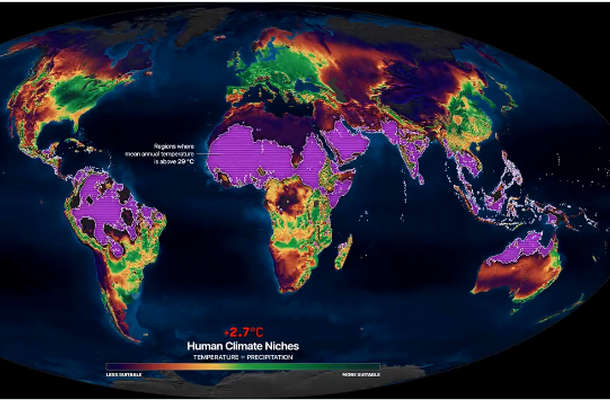
Two billion people will find themselves living in dangerously hot places this century if global warming reaches 2.7℃, research released today reveals.
Striking map from a new study by Lenton et al.: after 2.7 °C global warming the purple areas will basically be too hot to live.
A billion people could be on the move to cooler lands.
Guardian article: https://t.co/a2AOQ24Dml
The study (open access): https://t.co/yAamRxs4us pic.twitter.com/yAciTULxkE— Prof. Stefan Rahmstorf (@rahmstorf) May 23, 2023
The authors calculated how many people would be left outside the “human climate niche” by 2100. The niche is defined as places with an average temperature of about 13℃, or about 27℃ in the tropics. Human population has historically peaked in these areas.
The world is on track for 2.7℃ of warming by 2100. This would push a third of people on Earth outside the human climate niche. This includes people in parts of northwest Australia such as Darwin, Broome and Port Hedland. It also includes parts of Southeast Asia, India, Africa and South America.
Limiting warming to 1.5℃ would substantially reduce the number of people exposed, including most of those affected in northwest Australia.
We were not involved in the research, which was conducted by researchers in the United Kingdom, China, Europe and United States. We are Australian experts in the health implications of global warming. Below, we discuss the broader implications of these globally significant findings.
What is the human cost of global warming?
The research calculated the number of people outside the “human climate niche” under different demographic scenarios and levels of warming. Exposure to unprecedented heat was the main factor pushing people out of the niche.
This includes an average temperature greater than or equal to 29℃, as well as a high number of days with a maximum temperature above 40℃ or in humid places, with a wet-bulb temperature greater than 28℃. The wet-bulb temperature (as opposed to the standard dry-bulb temperature) reflects humidity and is a method used to measure heat stress. That’s because it’s the point at which sweating is no longer effective as a means of cooling.
A group of young people read this article and then went quiet for half an hour – and then one said "silly me for thinking we had a future".
The moral depravity of @guardian for publishing such information and then doing nothing is beyond words.@KathViner https://t.co/A7VcqeeQWX— Roger Hallam (@RogerHallamCS21) May 26, 2023
The study says a wet-bulb temperature of 35 ℃ can be fatal, especially for vulnerable people, because the body can no longer cool itself.
Above the present level of about 1.2 ℃ global warming, the authors found exposure to unprecedented average temperatures increased markedly, along with increased exposure to temperature extremes.
But 2.7 ℃ of warming threatens a third of the world’s population. The below map shows where in the world people will suffer the worst heat. Almost the entire area of some countries, such as Burkina Faso and Mali in West Africa, would be exposed to unprecedented heat.
Why is warming a health hazard?
Just last week, the World Meteorological Organization predicted global surface temperatures would rise to record levels within the next five years. The temperature is also likely to temporarily climb 1.5℃ above pre-industrial levels.
Global temperatures are likely to surge to record levels in next 5 years, fuelled by greenhouse gases and El Niño.
There is a 66% likelihood of temporarily exceeding 1.5°C in at least one year.#ClimateChange
🔗https://t.co/4PpgpKoHwL pic.twitter.com/WjXRoDRPE1— World Meteorological Organization (@WMO) May 18, 2023
This spells trouble for human health. Even incremental warming increases exposure to health hazards including potentially deadly heatwaves, infectious diseases and diet-related health issues.
Let’s be clear. A 1.5℃ world will result in injury and death, particularly for people in Asia and Africa. Importantly, the people most at risk will be the least capable of protecting themselves: children, the elderly and those with existing health conditions.
While populations closer to the equator are more likely to experience heat-related harm, Australians are by no means immune.
For example, a 2019 study found heat-related health issues in Australia have been grossly underestimated. It found more than 36,000 deaths between 2006 and 2017 were attributable to heat.
And experts predict Darwin could experience an average 265 days a year above 35℃ in a 3℃ warmer world.
As in other parts of world, primarily high-risk populations in Australia will experience some of the worst impacts from a changing climate. In essence, climate change creates and maintains health inequities.
To date, the Earth’s average surface temperature has warmed 1.2℃ above pre-industrial levels. We must enact ambitious climate policies now if we are to change our dangerous trajectory.
For too long, we have focused disproportionately on the economic costs of climate action for current – often wealthy – groups at the expense of considering the economic costs of inaction for all, including future generations.
map from a new study by Lenton et al.: after 2.7 °C warming, the purple areas where a billion people live will basically be too hot to live. And 2.7°C is anyway an optimistic IPCC projection based on our current trajectory.
Guardian article: https://t.co/V7Hxiojdr6 https://t.co/O44MzKhdpo
— Civilization collapse technician Keenan Roberts (@HowKeen) May 25, 2023
Historically health has rarely been included in these economic assessments, much less ethical considerations. Emissions reduction policies need to consider health and equity issues, and in doing so can provide governments with a strategic rationale to act.
How can extreme heat harm health?
There are multiple ways in which climate change can harm human health. Extreme heat can have direct effects, such as dehydration and heat stroke. Groups most at risk include the elderly and those already unwell.
Extreme heat can also harm mental health, increasing rates of injury and death by aggravating existing mental illness. Beyond direct effects, heat can affect health by influencing, for example, agricultural productivity, water security and air quality.
There are physiological limits to adaptation, particularly to heat. These limits can have negative consequences for labour productivity, especially for outdoor workers, and for health service demand, leading to increased hospital admissions, emergency department visits, and ambulance calls.
Pursuing adaptation measures in an effort to reduce the harmful effects of existing climate change is vital, but to protect the health of all, it is critical that we pursue strong emissions reduction measures.
Developing healthier climate policies
Australian climate action targets have improved under the Albanese government, however they remain incompatible with keeping warming to 1.5℃.
Approving additional coal projects is not helpful for reducing emissions or demonstrating climate leadership.
A commitment to develop and implement a National Health and Climate Strategy and establish a National Sustainability and Climate Unit are promising initiatives. This will help to address our woeful performance in a recent assessment showing how national climate commitments don’t link with health.
The world is on course for 2.7°C warming by the end of the century – far above the 1.5°C target of the Paris Agreement
Limiting warming to 1.5°C would save billions of people from dangerous heat, as this video by @Globaia shows pic.twitter.com/HIJcSmO8fX
— University of Exeter News (@UniofExeterNews) May 22, 2023
Last week, the Victorian Government committed to reducing emissions by 75-80% compared with 2005 levels by 2035. Their analysis indicates it will lead to A$5.7 billion in health benefits from improved air quality between 2035 and 2045.
As today’s new research states, the findings highlight the need for “more decisive policy action to limit the human costs and inequities of climate change”. Australia, in particular, must protect children, the elderly and the broader population from the harms they face in a warmer world.

The Dire Difference Between 1.5 And 2 Degrees Of Warming – Cheddar News
World on track to see temperature rise of 2.7C, says UN
Climate crisis: Where will it be too hot to live? – BBC Newsnight
Global Warming Will Likely Breach Key 1.5C Threshold For First Time By 2027
Be sure to ‘like’ us on Facebook