




By Karen Hanrahan | 26 May 2026
The Conversation
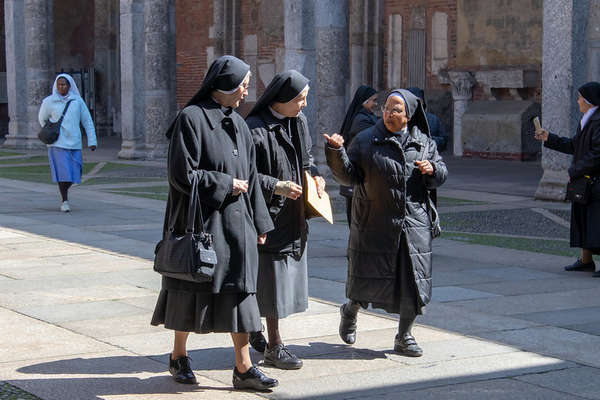
Any thoughts of escaping to a more natural life was regarded as being sinful. The idea of being unfaithful to your vocation was a step on the way to hell. It would be a mortal sin.
These are the words of Mary, my mother. She was just 15 when she entered a convent in Ireland in 1950 and 34 by the time she finally managed to leave. She had been expressing doubts to her superiors since her early twenties but years of “brainwashing” and the very real fear of her and her family facing eternal damnation made breaking her vows seem impossible.
Speaking to my mother, as well as to five other nuns and former nuns for my PhD research, gave me a glimpse into a way of life which no longer exists. Their often heartbreaking narratives paint a picture of a repressive and damaging regime which emphasised self-sacrifice and unquestioning obedience and where suffering and “breaking the spirit” supposedly brought you closer to heaven.
For many who left the convent, the years of “grooming”, “mind control” and “infantilisation” made adjusting to secular life a significant challenge – mentally, socially, emotionally and financially. Few were supported in this transition.
The image of the “evil nun” has become almost a caricature in recent years, particularly in Ireland, where the fallout from decades of abuse scandals has left a deep scar, radically changing perceptions of the Catholic church. These women’s stories offer an insider’s perspective of life within the convent walls and hopefully provide a more nuanced view of just what it was like to wear the habit and then, eventually, to cast it aside.
The women I spoke to were just children when they entered the convent, with hopes of making a better life for themselves but without any real understanding of what lay in store. Instead, they were manipulated and brainwashed. One woman was sexually abused by an older priest at the age of 15, while another had a mental breakdown and went on hunger strike in a cry for help which was ignored.
The winds of change
No study currently exists which specifically explores the testimonies of former “women religious” (both nuns and sisters) in Ireland, particularly those who entered religious life before the Second Vatican Council (1962-1965).
Instigated by Pope John XXIII and with an emphasis on aggiornamento (updating or modernisation), the Second Vatican Council was characterised by a spirit of renewal and self-reflection. The winds of change blowing from Rome ushered in a raft of seismic transformations throughout the Catholic church. For example, following Vatican II, mass was no longer given in Latin but in the vernacular, and the position of the altar was turned around so that priests didn’t have their backs to “the people of God” as they delivered Mass.
Indigenous leaders said the discovery underscores the fact there are likely many more unmarked burial sites stemming from residential schools across the country that have yet to be found — and they urged officials to provide the resources to locate them. https://t.co/l6fiHO1K3I
— Toronto Star (@TorontoStar) May 29, 2021
Following Vatican II, nuns gradually enjoyed more autonomy. For example, they could take more personal responsibility in decision making, they were allowed to cultivate friendships within and beyond the convent, and they could learn to drive (something that they had previously been unable to do).
Before Vatican II convent hierarchies were much more rigid. An individual nun had to surrender her will to her superior and was no longer in control of her destiny. A number of the women in my study (who, apart from my mother, I will not be identifying or using real names for) said that their lives and duties could vary significantly depending on whoever held that office. An unquestioning acceptance was expected and the emphasis was on self-sacrifice, renunciation of the self and conforming to life in community.
My mother and the end of an era
The six women I’m working with entered a religious congregation in Ireland in the 1950s, when they were between 13 and 16. They grew up in different convents and worked as sisters and teachers in various schools in Ireland, England and East Asia. Four spent between 15 and 27 years in religious life before leaving and two remained. They are all now in their eighties.
I felt very strongly that their stories needed to be captured before they were lost because, within the patriarchal Catholic church, an “archaeology of exclusion” has rendered nuns almost invisible in the historical record.
The fact that leftists use the Handmaid's Tale to protest Christianity while ignoring the fact that it's way more similar to Islam will never not be hilarious to me. https://t.co/rLno4XPOyh
— Lauren Chen (@TheLaurenChen) August 24, 2026
The voices of former nuns are afforded even less space. Religious women formed the largest and most powerful group of professional women in Ireland for much of the 20th century. And yet congregations of teaching sisters in Ireland have been in decline since the late 1960s.
My investigation into these hidden lives began with my mother. Now well into her eighties, she still has a recurrent nightmare of not being able to escape the convent:
I’ve had for years the dream, the nightmare, of travelling through high grass with a bicycle. I’m in the wrong place – should be out on the road … Or I’m climbing over a wall, trying to get down and finding it difficult. Certainly, it was years of this thing in your head all the time, you know, you shouldn’t be here but I’m here. What can I do? You were told there was a light shining down on top of you from heaven and you were picked, you were chosen. Really, a stupid kind of way of describing a vocation.
I cannot remember when I first learned that my mother was a nun for almost two decades. My relationship to this aspect of her life story has evolved considerably. As a child, I think I adopted a position of active not knowing, feeling that my mother’s status as a former nun was somehow shameful and made us different in small town Catholic Ireland where I grew up. A “spoilt nun” or a “spoilt priest” was the description for those who left their vocation (often described as the “call” to religious life). There was a stigma attached to such transgressions. Some of the women in my study kept this part of their past secret to all but close family. One woman avoided telling her children about her former identity until they were adults.
As a teenager, I remember feeling a burning sense of injustice on my mother’s behalf and was horrified at the idea of her confinement. She had consistently expressed doubts about her vocation, believing herself to be unsuited to life as a sister. How could her superiors turn a blind eye to her repeated requests to leave? At 15, the age my mother entered the convent, I prized my growing independence and found the idea of complete submission and erasure of self incomprehensible.
As I grew older, I moved on to a deeper understanding of her former identity but still felt protective of her and was resistant to talking about it, in case she became an object of curiosity.
But when it comes to families, all our stories get tangled up. My mother’s story is a part of my story. My own daughter is now 15, and it brings home to me the vulnerability of “being groomed”, as one of the women describes her experience of entering the convent.
Entering the convent
While it is undoubtedly the case that some young women believed that they had a vocation and were answering “the call” from God, becoming a nun afforded opportunities for women in Ireland at a time when they were not visible in public life. The surge in vocations in Ireland continued until 1967 and can be attributed to a desire for education, professional opportunities, economic stability or a life of adventure as a missionary. Having a nun or priest in the family boosted a family’s social capital. Religious life conferred a privileged identity within a powerful, transnational institution.
A Muslim man stormed a church in France, growling like a rabid animal, and attempted to attack nuns and worshippers. Christians are under attack everywhere. pic.twitter.com/ZufS5XxKFG
— RadioGenoa (@RadioGenoa) July 17, 2026
The attraction to religious life could also be interpreted as a sign of women actively seeking an alternative to marriage and motherhood rather than a reaction to a lack of eligible bachelors. In the case of the women in my study, given that they were children when they entered (between 13 and 16) it is safe to assume they were not left “on the shelf”.
Canvassing by religious orders was common at that time as “getting vocations” was key to an institute’s growth and success. The Catholic church was akin to an empire, a transnational institution whose reach and governance extended far beyond national borders. Nuns representing various Irish and international orders visited schools and sometimes local farms with large families as part of their recruitment drive, often showing alluring films of life on the missions.
In the Ireland of the 1950s (and indeed until the demise of the Catholic church in the 1990s), priests and nuns enjoyed positions of power and privilege in Irish society and adopting a deferential, unquestioning acceptance of religion was expected. Ireland was, therefore, an important recruitment channel for young postulants (the title given at the first stage of entry into a congregation).

The Missing Children: Ireland’s Mass Grave (Crime Documentary)
Excavations begin at child mass grave site in Ireland • FRANCE 24 English
How the Catholic Church Hid Away Hundreds of Irish Children | Times Documentaries
Abused nuns reveal stories of rape, forced abortions
Be sure to ‘like’ us on Facebook












