By Joseph Carvalko | 13 July 2026
Church and State
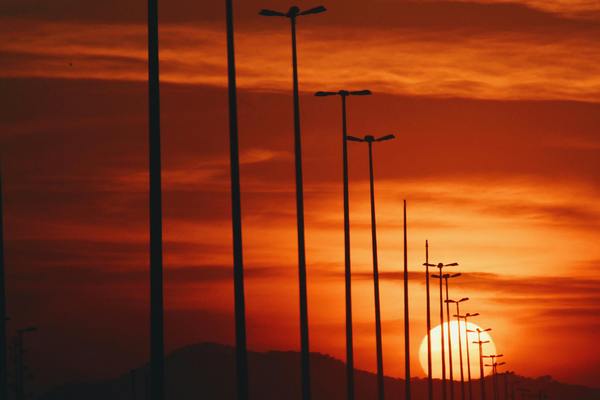
We spent this year’s Fourth of July, the nation’s 250th birthday under a heat dome that put Philadelphia at 100 degrees, the same city where, 250 years earlier, Thomas Jefferson recorded a “mild” 76 on the day the Declaration was signed. Triple-digit heat disrupted Independence Day fireworks up and down the East Coast, forced World Cup organizers to schedule water breaks for players competing in unsafe conditions, and killed dozens of people. Scientists at World Weather Attribution concluded within days that the heat and humidity combination would have been virtually impossible without fossil fuel pollution. A second heat dome then rolled over the West. In between, an El Niño now developing in the Pacific, potentially the strongest on record, is expected to keep loading the dice toward more of the same through the rest of the year.
I’m not a climate scientist, but it doesn’t take a PhD to realize that the world’s weather is dramatically changing. On the nightly news weather reporters rush through a segment that tells us how temperatures and storms dance across the country but rarely say more. Comic George Carlin regularly pigeonholed the nightly weatherman as a pseudo‑authority delivering obvious or useless information with great seriousness. Even though I’d heard his routine dozens of times I always laughed at his character Al Sleet, the Hippy‑Dippy Weatherman who’d tell his audience “Tonight’s forecast: Dark. Continued dark overnight, with widely scattered light by morning.” Seriously, if it weren’t for our trusty weather reporters we would hear nothing about what’s actually happening to our climate, or more pointedly our planet.
I teach Law, Science and Technology to budding lawyers. Each year we take a morning to discuss the matter of climate change as an object lesson in how science information is drowned out if not actually censored by the administration. It’s a classic example of the busy intersection of politics, law and science, where the latter two are conveniently buried by the government, mainly to satisfy the monied interests of the fossil fuel industry.
More than 2,700 deaths linked to May and June heatwaves.
Dr Clair Barnes, from Imperial College, has warned that if we don't slow the rate of global warming, the number of people dying from heat stress will overtake the number of people dying during the winter pic.twitter.com/sRKUIaGw74
— Sky News (@SkyNews) July 13, 2026
Unfortunately, none of the recent bad weather is an instance of an isolated bad summer. It followed a March heat wave across the U.S. Southwest so extreme that climatologists ranked it among the handful of most astonishing weather events of the century, an unusually active severe-weather season that had the Chicago area logging nearly three times its typical number of severe-thunderstorm days by mid-April, and a winter storm in January that killed more than 170 people across the U.S., northern Mexico, and Atlantic Canada.
This pattern isn’t confined to American headlines, either: Europe has faced an intense battle with extreme heat this year, marked by unusually early and persistent heatwaves that shattered temperature records across the continent. Western Europe saw daily averages more than 10°C above normal, with countries like France, Portugal, the UK, and Ireland recording their hottest May temperatures ever observed. By June and July, heat intensified further, driving record sea surface temperatures, worsening drought conditions, fueling wildfires, and contributing to thousands of heat related deaths. Meteorologists attribute these extremes to a combination of persistent high pressure “heat dome” systems and broader climate driven warming trends, with Europe now warming faster than any other continent.
Half-way around the world, this spring, storms killed more than a hundred people in India’s Uttar Pradesh state, floods forced a nationwide cleanup in Ghana, and a landslide buried dozens in Indonesia. Climate change has stopped being a projection about the world our grandchildren will inherit. It is now simply what the weather is doing.
The mechanism behind all of this hasn’t changed either, but it’s worth restating because it’s the part skeptics rarely engage with directly. Earth has a natural supply of greenhouse gases that trap heat while letting sunlight in freely. Heat radiated back from the planet’s surface must pass back out through the atmosphere, and molecules in each layer absorb a portion of it on the way. Add more carbon dioxide, from, you guessed it, burning fossil fuels and clearing forests, and more of that outgoing heat gets captured before it escapes, warming the planet a little more with each added molecule. This isn’t a new or contested mechanism; it’s basic radiative physics, confirmed and refined for well over a century.
How climate change made Europe’s extreme June heat worse
In the first part of our special Substack mini-series examining the impact of climate change, @liamdutton explores why temperatures are rising and heatwaves are becoming more frequent.
📩Read our latest newsletter here:… pic.twitter.com/EJr1VgjLs5
— Channel 4 News (@Channel4News) July 13, 2026
And yet, in February 2026, the Trump EPA, under Administrator Lee Zeldin, formally repealed the 2009 Endangerment Finding, the scientific determination that greenhouse gases threaten public health and welfare, and the legal foundation underneath nearly every federal rule limiting climate pollution from cars, power plants, and industry. Notably, the agency didn’t try to relitigate climate science to justify the repeal. It argued instead that the Clean Air Act never gave EPA the authority to regulate greenhouse gases this way in the first place. This is a legal argument, not a scientific one. That distinction matters. It means the administration’s own repeal implicitly declines to dispute the scientific explanation of the underlying mechanism. The fight isn’t about whether the planet is warming or why, it’s about whether the government is obligated to do anything about it.
That’s worth sitting with, because skepticism of an established scientific theory is not inherently disreputable. Science advances through exactly this kind of challenge, through self-critical assessment, replication, and a willingness to revise conclusions when the data demand it. But not every skeptic has an equal vote. A challenge to settled science earns its standing by doing the work which means: (a) pointing to competing data, (b) showing where a model fails to account for an observed feature, (c) identifying flawed sampling, (d) or the lack of peer review, or that (e) a claim’s been made that can’t be falsified. What a skeptic doesn’t get to do is reject a theory merely because accepting it is inconvenient to a constituency’s interests, or because the underlying physics is unfamiliar. On the current state of the science, the count still isn’t close. Something on order of 13,000 peer-reviewed studies support the conclusion that human activity is driving global warming, against roughly 100 that don’t.
Meanwhile, the questions climate skeptics would need to answer are getting increasingly harder to dodge. What accounts for a Southwest heat wave large and strange enough to be called one of the most astonishing weather events of the century? What explains sea surface temperatures hitting all-time highs, an Antarctic heatwave thirty-six degrees above normal enough to rain on glaciers, or a “danger season” of heat, drought, wildfire, and flood arriving earlier and hitting harder each year? Extreme heat, notably, is now the deadliest weather-related hazard in the United States. This means deadlier than hurricanes, floods, and tornadoes combined. An administration is entitled to disagree with the weight of scientific opinion. It is not entitled to simply decline to explain what, then, is causing all of this.
In 1985, Carl Sagan told Congress that continuing to burn fossil fuels will increase global temperature, cause climate change, melt glaciers and ice sheets, and cause sea level rise. Imagine if we had listened to him them.
No time to wait. #ActOnClimate #climate pic.twitter.com/IPQYbolWn8
— Mike Hudema (@MikeHudema) July 6, 2026
Disclaimer: none of what’s written here means every future storm season will individually mark some abrupt discontinuity, or that any single flood or heat dome can be attributed to climate change by itself with certainty. And this of course is the wall behind which climate-deniers hide. But that is no longer the operative question. Attribution science has matured enough that researchers can now often answer, within days, whether and by how much climate change made a particular event more likely or more severe, and the answer, increasingly, is a great deal. The country that once debated whether climate change was coming is now living through what it looks like when it has arrived, three heat domes and a repealed endangerment finding into the same calendar year in which it also relitigated whether the government has any duty to respond.
Between Two Eternities: Inscriptions Buried in an Awakened Heart by Joseph Carvalko. https://t.co/4X5oPVFFz5
— Church and State (@ChurchAndStateN) October 9, 2024

Joe Carvalko on the Intersection of Law, Science, and Technology
2050: what happens if we ignore the climate crisis
Survey: 77% of climate experts expect temperature rise by more than 2.5° by 2100 | DW News
New climate data shows global temperatures continuing to rise sharply | DW News
Be sure to ‘like’ us on Facebook