




By Donald A. Collins | 30 May 2025
Church and State
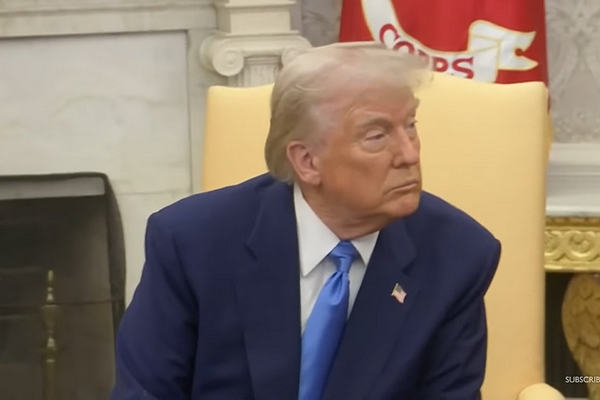
The following has been created by ChatGPT.
Donald Trump has often been accused by critics, scholars, and political commentators of using fear as a political tool to mobilize support, consolidate power, and frame political discourse. Here are several key examples where Trump used fear-based rhetoric to influence public opinion and gain or maintain power:
Terry Moran is one of the few journalists who challenge the lies told by #Trump.
Others won't because they fear losing press access to the administration.@TerryMoran's courage highlights how many other journalists have let us down.
Their silence is a disservice to America. pic.twitter.com/yS0AkoIYKF
— Matthew VanDyke (@Matt_VanDyke) May 1, 2025
1. Immigration and the “Caravan” Crisis (2018)
Rhetoric: During the 2018 midterm elections, Trump repeatedly warned about “migrant caravans” coming from Central America, describing them as filled with criminals, gang members, and possible terrorists.
Impact: This stoked fear among voters about border security and helped rally his base around hardline immigration policies. He deployed thousands of troops to the border in what was largely seen as a political move.
Example Quote: “You have people coming into your neighborhood that are rough, they’re tough, they’re bad. And you know what? If we had proper border security, you wouldn’t have that.”
2. “American Carnage” Inaugural Speech (2017)
Rhetoric: Trump’s inaugural address painted a dark and dystopian picture of the United States, using terms like “American carnage” to describe inner-city violence, job losses, and failing infrastructure.
Purpose: The speech appealed to fears of national decline and moral decay, justifying a dramatic shift in leadership and policy direction under his administration.
Quote: “This American carnage stops right here and stops right now.”
"Antisemitism is a pretext."
We speak with esteemed historian scholar Ellen Schrecker about the Trump administration's assault on universities and the crackdown on dissent, a climate of fear and censorship she describes as "worse than McCarthyism." pic.twitter.com/jS1YvRCgQl
— Democracy Now! (@democracynow) May 30, 2025
3. Muslim Ban and Fear of Terrorism (2015–2017)
Rhetoric: Trump proposed a “total and complete shutdown of Muslims entering the United States” during his 2016 campaign, linking Muslim immigrants and refugees to terrorism.
Policy: This culminated in the controversial travel ban affecting several predominantly Muslim countries.
Effect: This policy and rhetoric tapped into post-9/11 fears and cast a wide group of people as potential threats to national security.
4. Antifa and “Law and Order” (2020)
Rhetoric: Amid protests following George Floyd’s murder, Trump frequently blamed Antifa and “left-wing extremists” for violence and chaos, framing cities as war zones under siege by radicals.
Purpose: Trump positioned himself as the defender of “law and order,” appealing to suburban and older voters concerned about safety.
Quote: “The only thing standing between the violent mob and the American dream is me.”
5. Voter Fraud Claims (2020 Election)
Rhetoric: Trump repeatedly claimed, without evidence, that the 2020 election was being stolen due to widespread voter fraud.
Effect: These false claims sowed doubt about the legitimacy of democratic institutions, culminating in the January 6 Capitol insurrection.
Purpose: Critics argue this fearmongering about election integrity was designed to delegitimize the outcome and retain power.
6. COVID-19 and China
Rhetoric: Trump labeled COVID-19 as the “China Virus” and warned that Biden would be soft on China, implying that a Democratic win would endanger American health and security.
Effect: This served to externalize blame for the pandemic and shift public anger and fear onto foreign entities and political rivals.
Conclusion:
Fear has been a central tool in Trump’s political strategy. By amplifying perceived threats—whether from immigrants, crime, terrorism, or political opponents—Trump has often positioned himself as the only one who can protect the country. This technique has historical precedents in authoritarian and populist politics around the world.
 Former US Navy officer, banker and venture capitalist, Donald A. Collins, a free lance writer living in Washington, DC, has spent over 50 years working for women’s reproductive health as a board member and/or officer of numerous family planning organizations including Planned Parenthood Federation of America, Guttmacher Institute, Family Health International and Ipas. Yale under graduate, NYU MBA. He is the author of “From the Dissident Left: A Collection of Essays 2004-2013”, “Trump Becoming Macbeth: Will our democracy survive?”, “We Humans Overwhelm Our Earth: 11 or 2 Billion by 2100?”, “What Can Be Done Now to Save Habitable Life on Planet Earth?”, “Vote”, “Can Homo Sapiens Survive?”, “Will Choice and Democracy Win?”, “Can Our U.S. Survive 8 Plus Billion of Us”, “Economic Growth: A Cancer on all Earthly Life”, “On the Precipice of Political Disaster in 2024”, “Democracy at Red State Risk”, “Does Trump Go to Jail or to The Oval Office?”, “Trump: Pardon or Punish?: The Nixon Precedence Was Not A Trump Coup Denied!”, and “Common Sense: When will Trump be Impeached, Indicted, and Exited?”.
“What Can Be Done Now to Save Habitable Life on Planet Earth?”: https://t.co/fHuh0CG6JD
“We Humans Overwhelm Our Earth: 11 or 2 Billion by 2100?”: https://t.co/TA4j7cp1tE
“From the Dissident Left: A Collection of Essays 2004-2013”: https://t.co/lkC2t3E1A9 pic.twitter.com/bQsL2mLBcO— Church and State (@ChurchAndStateN) November 1, 2021

Presidential Historian: Trump Has Tried to Introduce Fear in First 100 Days | Amanpour and Company
‘Not even remotely normal’: New concern over Trump’s rambling speeches, posts
We Need to Talk About Fighting Fascism in America!
Be sure to ‘like’ us on Facebook







