




By Prof. David Eller | 30 September 2025
Shuddhashar
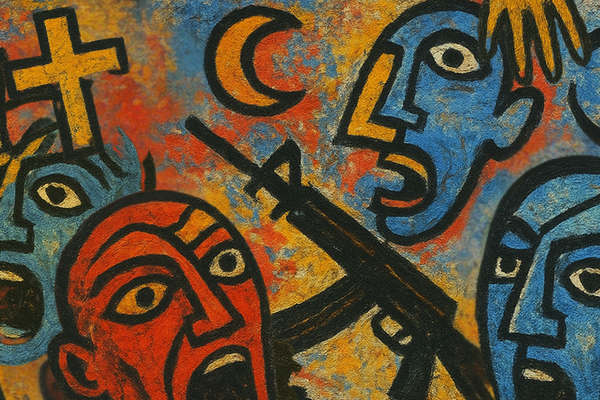
Originally conceived in Hebrew and Greek traditions as words that offend deities, blasphemy has morphed in the present day into a battle of images and a cry of subjective emotional pain, which anyone can use against anyone to silence and dominate them.
According to blasphemy scholar Leonard Levy, blasphemy simply but very broadly refers to “speaking evil of sacred matters” (1993: 3) and comes to the Western world initially from Hebrew scripture. For instance, Exodus 22:28 warns, “You shall not revile God, nor curse the ruler of your people.” (American Christian conservatives may want to consider the second half of that verse before they verbally attack Democratic presidents like Obama and Biden.) The English term, derived from the Greek blasphemein, composed of blaptein (to harm) and pheme (act of speech), reinforces the basically linguistic nature of the offense. Contrary to folk wisdom, words really can harm you and can apparently harm the gods too.
Of course, blasphemy—as one species of sacrilege, from the Latin sacrilegium for temple robbery (sacer, sacred + legere, to steal)—extends well beyond speech to include actions as well as images that desecrate (de-sacralize or threaten the sacredness of) religious ideas, objects, and persons. So, blasphemy and its synonyms and cognates were never limited to language alone. Nor were they ever restricted to “reviling” the gods but equally if not more to disbelieving in the gods or in any particular point of dogma or to believing in the wrong gods/dogma, causing blasphemy to shade into heresy.
In the present day, blasphemy has morphed into a distinctly postmodern and postdigital form. This is ironic because secularization theory predicted that religion would fade in modern urban society, and therefore, as Rollier, Frøystad and Ruud write in the introduction to their recent volume on religious “outrage” in South Asia specifically, “the belief in blasphemy is often dismissed as a relic of the past or as an anachronistic aberration” (2019: 5). That is, by now people were not supposed to care so much about things like offensive religious speech. Instead, today we see a new wave of blasphemy accusations (and sometimes deliberately and gleefully blasphemous utterances, images, and actions) that we could call Blasphemy 2.0 because they differ from past, especially ancient, forms in two notable ways.
Christopher Hitchens predicted in 2009 that the term ‘Islamophobia’ would eventually be used to criminalize any speech that is critical of Islam.
The whole concept of ‘Islamophobia’ is about implementing Sharia blasphemy laws in the West.
– @realMaalouf pic.twitter.com/X3WmPzV8Ae
— Imtiaz Mahmood (@ImtiazMadmood) May 29, 2025
The first new feature of Blasphemy 2.0 is, predictably, its entanglement with digital technologies and social media. Programs like Photoshop and devices like computers and smartphones allow almost anyone to be a visual blasphemer, and AI image generators make creating blasphemous content easier and more ubiquitous. Social media, then, facilitates “the proliferation of potential transgressions and allows a degree of anonymity to its users, which reduces the threshold for sharing transgressive content” (Rollier, Frøystad and Ruud 2019: 32). Consequently, there are potentially more blasphemous words and images now than before with greater, including global, reach. For instance, in Kathinka Frøystad’s chapter in the aforementioned volume, she discusses the production and circulation of provocative images in India that pit Hindus against Muslims. Among these are (necessarily) fictionalized visuals of the Hindu god Shiva hovering over the Qa’aba in Mecca, the holiest site in Islam (see images 1 and 2).
— Church and State (@ChurchAndStateN) October 1, 2025
Image 1 Shiva sitting on the Qa’aba. Source: the-militant-atheist.org, reproduced with permission
— Church and State (@ChurchAndStateN) October 1, 2025
Image 2 Shiva hovering over the Qa’aba. Produced by the author using DeepAI image generator
More importantly, such pictures portray the fringe but significant political mythology that Hinduism predates Islam in the Middle East and that the latter is a continuation or a corruption of the former. Frøystad reports, accordingly, that many Hindus believe that the Qa’aba was originally a Shiva temple or even that it is still a Shiva temple, with the god literally trapped inside and feebly begging “‘Mujhe dudh pilao, mujhe dudh pilao’ (please give me milk)” (134). Two Brahmin priests whom she interviewed expounded that the captive god could be released if the structure was sprinkled with holy water from the Ganges River, but they appreciated “that such an act could well destroy the entire religion (islam ko tor dena). This was evidently not a desirable option” (134).
Apparently, this idea that Islam is a (bastard) child of Hinduism reaches back at least to the mid-1800s, promoted for instance by Purushottam Nagesh Oak, who taught not only that the Qa’aba was formerly a Hindu temple but that the name of the city of Mecca derived from the Sanskrit word makha for a sacrificial fire and that Arabia was once part of a Hindu kingdom. Depressingly but unsurprisingly, this narrative appeals to contemporary Hindu nationalists: “By 2016 at least 20 assemblages of photos, film clips and accompanying text circulated online, all attempting to illustrate Oak’s main points with authoritative voice-over explanation in English, Hindi and other Indian languages, occasionally with subtitles” (140). Muslims, on the other hand, do not find the idea appealing or amusing, and Frøystad asserts that “such images were almost guaranteed”—if not designed—“to offend Muslims, for whom the imagination of any power supreme to Allah represents heresy” (142). Inevitably, unrest and violence has ensued.
Charges of blasphemy fly back and forth in some societies as one of the most effective methods to censor and censure dissenting opinion and marginalized identity—including non-majority and non-hegemonic positions within one’s own religion.
The second noteworthy feature of Blasphemy 2.0 is its profound subjectivization, psychologization, or personalization. That is, whereas blasphemy in the Hebrew and Greek version was understood to offend God or the gods, in current instances it deeply emotionally offends individual believers. Certainly, this is not entirely new: ancient Hebrew, Greek, and other citizens were often personally outraged by behavior like destroying religious artifacts, refusing to perform sacrifices, or denying the existence of deities. Nevertheless, today we see an epidemic of blasphemy experienced as personal insult and hurt feelings. We wonder, along with Rollier, Frøystad and Ruud, “Why did allegations of hurt religious sentiments become so pronounced” in South Asia and elsewhere in recent years? Already in colonial India in the 1860s, the path was set with the Indian Penal Code, which sought to prevent interreligious hostility by criminalizing words, sounds, and gestures that could “wound” a believer’s “religious feelings” (section 298). Sixty years later, once again to assuage sectarian tempers, authorities introduced a “Religious Insults Bill” with the goal to outlaw “not only spoken offense but also any representation intended to ‘outrage’ religious feelings”; section 295-A proposed fines or imprisonment for anyone who, “with deliberate and malicious intention of outraging the religious feelings of any class of His Majesty’s subjects, by words, either spoken or written, or by visible representations, insults or attempts to insult the religion or the religious beliefs of that class.” Law in independent India, Pakistan, and Bangladesh has absorbed and extended these provisions, construing blasphemy as anything that upsets people and makes them feel bad or mad. The three authors dub this the “global economy of religious offense.”
Massachusetts still criminalizes blasphemy. Up to 1 year in jail. $300 fine.
Our testimony: repeal this archaic law. Free expression means no special shield for religion.
S. 2564 passed the Senate 40–0. Now the House acts.
Read the full statement: https://t.co/TGDgrEZZsf pic.twitter.com/8jxUiwkaMQ
— Center for Inquiry (@center4inquiry) September 25, 2025
What has not changed in Blasphemy 2.0 is, as Rollier, Frøystad and Ruud put it aptly, that “accusations of blasphemy form part of a series of established devices to restrict the freedom of expression” (18)—and not just of expression but of exercise and belonging, therefore let us say to restrict freedom. And since religious freedom or lack thereof is a political matter, we plainly see that affective intensity and “political instrumentalism” are not mutually exclusive. Indeed, the question immediately becomes, whose affective responses are politically instrumentalized and hegemonic?
To begin to answer the question, we can paraphrase Marx to the effect that the blasphemy accusations of a society are the blasphemy accusations of the dominant group of a society. Generally but not universally, in practice this means that the majority religion is “more eager to initiate blasphemy cases than others” (25) and usually more successful, since it also dominates the state’s legal apparatus and is more likely to be heard and honored by the state. This is especially so because, paradoxically perhaps, blasphemy—a fundamentally religious crime—is typically, even in devout countries like Pakistan, tried in secular (i.e., governmental) courts. Rather like medieval Christendom where religious officials turned offenders over to secular authorities for punishment, present-day blasphemy charges may originate from religious figures like Brahmin priests or Muslim clerics but are filed and prosecuted in secular spaces. In Pakistan, for instance, members of the ulema (Islamic scholars) are commonly involved in the instigation of so-called First Information Reports, which is how violations come to the attention of law enforcement (Rollier 2019: 54). This does not mean that the religiously-offended necessarily leave the matter in secular hands: in one situation, the extremist group Ahl-e-Hadith (People of Hadith) threatened to torch a police station lest an officer register their First Information Report. Often, religiously-affronted individuals take justice into their own hands, vilifying, attacking, and sometimes killing the alleged culprit.
Consequently, this regime of hurt religious feelings is “democratized” in a way, such that anyone can accuse anyone else of blasphemy on almost any grounds and, to an extent (up to and including death) enforce that accusation. This assures the multiplication and reciprocation of accusations. And, because emotions are subjective, no one can ultimately refute or deny a claim of hurt sentiments; in fact, to attempt to delegitimize such emotional pain is a second assault on the alleged victim. (Perversely, airing the alleged blasphemy in court is often regarded as further blasphemy, making such cases difficult to present.) Thus, charges of blasphemy fly back and forth in some societies as one of the most effective methods to censor and censure dissenting opinion and marginalized identity—including non-majority and non-hegemonic positions within one’s own religion. In Rollier’s chapter, rightly titled “We’re All Blasphemers,” he emphasizes that in Muslim-majority Pakistan, “Charges of blasphemy can indeed originate from, and be directed towards, Muslims of all persuasions” (Rollier 2019: 53), Barelvi Muslims condemning Deobandi or Ahl-e-Hadith Muslims and vice versa in endless rounds of dueling denunciations. Meanwhile, in Saudi Arabia, Muslims who diverge from Sunni/Wahhabi orthodoxy are subject to blasphemy charges. To be sure, minorities in the Muslim world like Alevis and of course Christians are targets of blasphemy allegations, since virtually anything they say or do will offend mainstream Muslims. Certainly too, foreigners who challenge or disparage local beliefs, with for instance rude images of Muhammad or Hindu gods, rile up religious sentiments and inspire calls for retribution. Blasphemy claims are thus effective tools to suppress dissonant voices and simultaneous expressions and methods of cultural and political supremacy.
Concerning to see an MP here calling for the reintroduction of a form of blasphemy laws
Blasphemy was abolished as an offence in England and Wales in 2008 under the last Labour government
In September, the UK Govt promised it would ‘never inhibit’ free expression on religions https://t.co/zbTwCIV1n1
— Humanists UK (@Humanists_UK) November 27, 2024
Granted, in some places like India, religious minorities have also exploited the regime of religious hurt to press their pleas for protections and privileges from the government (although, according to Rollier, Frøystad and Ruud, this courtesy has not yet been extended to atheists and secularists), on the premise that the majority is hurting the feelings of the aggrieved minority. Whatever the source, blasphemy complaints translate into, and sometimes provide legitimation for, demands of “respect” and “recognition”; even better, claims of grievous emotional harm are unimpeachable. In this way, Blasphemy 2.0 functions something like “culture” in popular imagination and political discourse: both carry the certification of authenticity, both presumed genuine. Further, like culture, blasphemy-as-emotional-pain sidesteps the problem of truth: it is irrelevant whether religious belief or culture is factually true as long as it is sincere. Ultimately, the point is that, once weaponized, subjectivized, and democratized, blasphemy charges in the guise of emotional hurt—or emotional hurt in the guise of blasphemy charges—can be utilized by anyone to activate the machinery of law against their antagonists and to gain materially, symbolically, or emotionally against those Others.
The contradictory thing is that blasphemy accusers exhibit no empathy for the hurt feelings (and often hurt bodies) of the accused, whose beliefs and identities are every bit as genuine and dear, and emotional (and physical) pain every bit as real and intense, as those of the accusers.
References:
Frøystad, Kathinka. 2019. “Affective Digital Images: Shiva in the Kaaba and the Smartphone Revolution.” In Paul Rollier, Kathinka Frøystad and Arild Engelsen Ruud, eds. Outrage: The Rise of Religious Offence in Contemporary South Asia. London: UCL Press, 123-47.
Levy, Leonard W. 1993. Blasphemy: Verbal Offense Against the Sacred, From Moses to Salman Rushdie. New York: Alfred A. Knopf.
Rollier, Paul. 2019. “‘We’re All Blasphemers’: The Life of Religious Offence in Pakistan.” In Paul Rollier, Kathinka Frøystad and Arild Engelsen Ruud, eds. Outrage: The Rise of Religious Offence in Contemporary South Asia. London: UCL Press, 48-76.
Rollier, Paul, Kathinka Frøystad and Arild Engelsen Ruud. 2019. “Introduction: Researching the Rise of Religious Offence in South Asia.” In Paul Rollier, Kathinka Frøystad and Arild Engelsen Ruud, eds. Outrage: The Rise of Religious Offence in Contemporary South Asia. London: UCL Press, 1-47.
Reprinted with permission from the author.
“Trump and Political Theology: Unmaking Truth and Democracy” by Prof. David Eller. https://t.co/HBd95Fca8P
— Church and State (@ChurchAndStateN) September 4, 2023

“The Truth Hurts: An Anthropological Perspective on Religion and Suffering” (Eller)
“We Should Be Allowed To Criticise Every Religion” | Labour’s ‘De Facto’ Blasphemy Laws
Pakistan’s Blasphemy Laws | Unreported World
Be sure to ‘like’ us on Facebook












