




By Joseph Carvalko | 6 June 2025
Church and State
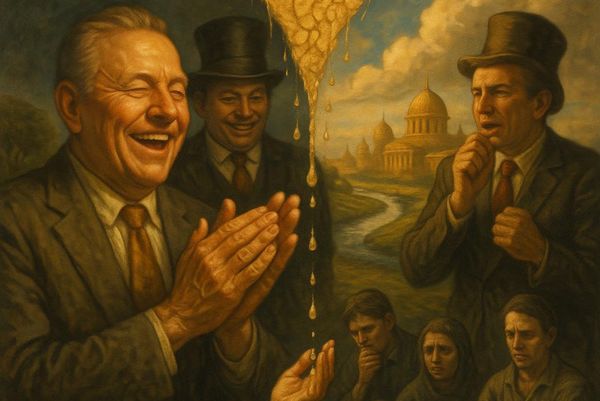
As of June 3, 2025, Donald Trump had held the office of President for 4 months and 14 days, and during this brief stretch of time, the repercussions of his administration’s policies and constitutional overreach were already reverberating worldwide, exacting devastating
consequences for some of the planet’s most vulnerable populations—the impoverished millions who had relied on U.S. food and medical aid for over six decades. Among the most dramatic of these consequences was the dismantling of the U.S. Agency for International Development (USAID), an institution founded in 1961 under President John F. Kennedy’s executive order to administer foreign aid programs promoting global economic development, humanitarian assistance, and democratic governance.
In January 2025, Trump signed Executive Order 14169, titled “Reevaluating and Realigning United States Foreign Aid.” This order initiated a 90-day freeze on all U.S. development assistance programs, ostensibly to allow for their comprehensive review. During this period, the State Department suspended the majority of existing foreign aid initiatives, sparing only emergency food assistance and military support to allied nations. The subsequent plan aimed to reduce USAID’s workforce—a team of more than 10,000 employees—down to fewer than 300, narrowing the agency’s focus to a handful of essential humanitarian and health initiatives, such as combating Ebola and supporting nations like Haiti and Ukraine. However, divisions within USAID devoted to democracy promotion, human rights, inclusive economic growth, and conflict prevention faced massive cuts. The immediate effects were devastating: HIV, tuberculosis, and malaria programs came to a standstill; food aid ceased; and disruptions undermined life-saving health services in regions like sub-Saharan Africa and the Middle East.
By March 2025, the U.S. Supreme Court intervened, ruling that the administration lacked unilateral authority to halt USAID’s funding. The Court’s decision lifted a temporary freeze on fund disbursements, compelling Trump’s government to resume payments to contractors and nonprofits dependent on USAID grants. Nevertheless, the administration delayed full compliance. Legal battles ensued, including orders from U.S. District Judge Amir Ali mandating the restoration of foreign aid funding and payment of overdue invoices. The administration responded with engineered delays, maneuvering around the Court’s directives and ensuring USAID’s inability to return to its former operational strength.
Finally, we’re starting to see some fight. We need more of this
Trump’s decision to shut down USAID has frozen critical work to deliver vital assistance around the globe, and put China in the driver’s seat. pic.twitter.com/JMrFOFx2VS
— Christopher Webb (@cwebbonline) February 3, 2025
In spite of multiple legal challenges—including rulings declaring USAID’s dismantling unconstitutional—a federal appeals court later overturned these judgments, clearing the way for the administration to restructure the agency. By March 2025, USAID had been officially shuttered, its functions partially absorbed by the State Department. This restructuring left the majority of USAID’s workforce laid off, while over 80% of its funding evaporated, ending vital programs that had been lifelines for millions across the globe.
Driving this historic downsizing was not merely Trump’s agenda but also the initiative of Elon Musk’s Department of Government Efficiency (DOGE), an agency authorized to review and reorganize federal programs with ruthless efficiency. Under Musk’s direction, DOGE oversaw the elimination or reduction of over 22 federal agencies and the termination of more than 107,000 government jobs in mere months. USAID bore the brunt of all four initiatives: shuttering, downsizing, restructuring, and elimination.
Observers noted that the dismantling of USAID seemed emblematic of a deeper shift in American political and cultural ethos. While it appeared true that Americans—regardless of class or political affiliation—were growing weary of extended commitments to assisting the world’s poorest, this weariness contradicted longstanding cultural values of empathy and decency. Historically, the United States had earned global respect for its humanitarian efforts, civil rights movements, and community-driven initiatives. Yet, with increasing frequency, politicians bent to the self-interested impulses of the nation’s elite—the billionaires whose philanthropy often skewed toward strategic motives such as tax benefits, brand enhancement, or geopolitical influence, rather than genuine altruism.
One particularly vocal critic of the administration’s moves was Bill Gates, who had long championed aid for the poorest children worldwide. Gates publicly condemned Elon Musk’s role in USAID’s demise, claiming that the cuts constituted an attack on the world’s most vulnerable populations. “The image of the world’s richest man killing the world’s poorest children is an intolerable one,” Gates declared, citing catastrophic consequences such as resurging outbreaks of diseases like measles, polio, and HIV, as well as essential food and medicine expiring unused in warehouses. Gates specifically highlighted the cancellation of health grants in areas such as Gaza and Mozambique, where programs had made strides to prevent HIV transmission from mothers to children.
The heartbreak
Trump wants us to believe that USAID is bankrupting America—when in reality, it’s less than 1% of the federal budget.
Meanwhile, Elon Musk—the richest man on Earth—is gutting the world’s largest provider of food aid. This is a man who could end world hunger… pic.twitter.com/5h8tRu5uw0
— Christopher Webb (@cwebbonline) February 23, 2025
The situation was made all the more tragic by the striking contrast between the priorities of the wealthy classes and the harsh realities faced by those barely clinging to life in impoverished corners of the globe. Gates noted that while some billionaire philanthropists—himself included—devoted resources to tackling global poverty and promoting public health, others, such as Musk, pursued visions of personal expansion in fields such as renewable energy, artificial intelligence, and space exploration. To Gates, the neglect of basic human needs in favor of lofty technological ambitions represented a fundamental betrayal of universal moral duties.
For many Americans, however, the significance of USAID’s collapse was lost in the fog of ignorance, indifference, or cultural bias. Those who had never ventured beyond their own borders, let alone witnessed firsthand the conditions faced by the global poor, found it easy to
overlook the importance of programs like USAID. Even those who had traveled abroad often failed to grasp the full texture of foreign lives—the mundane struggles and systemic inequities that shaped existence in Uganda, India, Brazil, or China. From the vantage point of tourists and business travelers, the plight of marginalized communities seemed distant, abstract—hardly urgent.
This collective indifference allowed Trump’s administration to proceed unhindered, leaving behind a quiet moral void. The shuttering of USAID ensured that only a meager fraction of America’s abundant resources would flow to those most in need. Meanwhile, figures like Trump and Musk celebrated their own financial victories, their clenched fists preserving gains that they viewed as symbols of their prosperity. Yet their refusal to acknowledge their moral obligation—grounded as it should have been in compassion and justice—left an ethical stain on the legacy of America’s affluence and capitalism.
Trump and Musk, bolstered by massive tax benefits for the wealthy, presided over a hierarchical system that allowed wealth to trickle sparingly through an exhausted middle class down to the “bottomed masses.” But for those at the very bottom—the parched plains of poverty—the trickle was insufficient to sustain life. Food aid programs disappeared, medicines ran dry, and the slow machinery of American bureaucracy ensured unnecessary deaths. And for all the wealth and political power amassed by America’s elite, none were immune to the judgment of history, nor to the inherent ugliness of greed. As Einstein famously observed, “Three great forces rule the world: stupidity, fear, and greed.”
BREAKING: Elon Musk and Jeff Bezos are popping champagne because House Republicans JUST passed Trump’s “big, beautiful bill.”
This bill is a BIG tax handout for billionaires, paid for by ripping health insurance from 14 MILLION people.
We must stop this from passing the Senate. pic.twitter.com/JxHN0yWpMT
— Elizabeth Warren (@SenWarren) May 22, 2025
Trump’s moral failings, alongside those complicit in USAID’s dismantling, brought to light a stark truth about human nature: it is easier to turn away from the suffering of others than confront the immensity of one’s obligations. In a world newly divided between the powerful and the powerless, those who orchestrated injustice sought refuge in distance, keeping the destitute out of sight and, ultimately, out of mind. Yet history rarely forgets, and neither does the collective conscience of humanity.
Between Two Eternities: Inscriptions Buried in an Awakened Heart by Joseph Carvalko. https://t.co/4X5oPVFFz5
— Church and State (@ChurchAndStateN) October 9, 2024

Joe Carvalko on the Intersection of Law, Science, and Technology
What to know about Trump, Musk and USAID
Chris Matthews: Trump wanted to give tax cuts to the rich and he did it with Medicaid
Be sure to ‘like’ us on Facebook












