




By Joseph Carvalko | 12 June 2025
Church and State
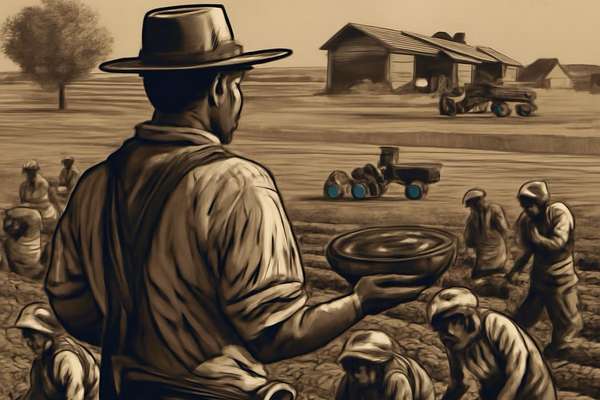
Currently we face another crisis caused by President Trump, a man who not once ever bent over to exert any form of back breaking work, in this case like that of the farmhand, who puts food on his table.
I don’t know a lot about farming, but I am not completely oblivious to its importance to our daily lives and the role immigrants play in their sustainability. As a kid I lived between one grandma’s home, in a city filled with factories, that employed immigrants, and my other grandma’s farm, of tilled fields, crops and animals, worked by immigrants, mainly herself. I witnessed back breaking work in both environs. I was fourteen, when my world changed from a kid playing baseball to working construction, jackhammering concrete, breathing in the sweet smells of asphalt. Some of my coworkers were citizens, yes, African-Americans, Puerto Ricans, and others were immigrants, Portuguese, Italians, Poles, and Hungarians, all damned to hear the pick, the shovel, the sledgehammer busting rock along the roads, every day till dusk, when each of us faded into our respective ghettos. Not long afterward, I would see other folks, farmers, who like we construction workers, broke their backs every day, tilling the soil, picking crops or stacking hay.
In the late 50s I moved west when I joined the service. It gave me an opportunity to work briefly on a farm/ranch in South Dakota. There farms could be separated from even small cities by fifty or a hundred miles. I would come to meet many farm workers over the next 20 years like Joe Duran, a typical westerner who made his living off the land along the Colorado and New Mexico border. It was in these very fields that men like Duran turned the soil and picked vegetables alongside the undocumented. Always side by side, their fates intertwined like roots beneath the topsoil—Mexicans and Americans on the same sun-drenched path of survival. There were no raids then, only the quiet communion of work. Cisterns waited to quench thirst; outhouses stood simple and functional against the wind. Technology was a stranger to these lives, and engines hadn't yet replaced the stubborn strength of mule-pulled plows.
Pope Leo XIV has called for priests, deacons and parish leaders to accompany migrants to court and stand in solidarity with them.https://t.co/1E3U4enkJT
— Anonymous (@YourAnonNews) June 13, 2025
Today I live in a farming community in the southwest among the folks that have tilled the land here for centuries. It rarely occurs to most that the first undocumented workers were the colonial Spaniard, followed by the pioneering Americans. These first immigrants hadn’t carried documents but instead brought their bare hands and their will. They hadn’t yet been wrapped in the scarlet letter of criminality that modern politics casts upon immigrants.
When WWII erupted, the country needed to fill the vacuum created by men going off to war. The Bracero Program (1942–1964) brought millions of Mexican workers to the U.S. legally, but even during and after the program, the demand for cheap labor led to continued undocumented migration. After the Bracero Program ended in 1964, undocumented migration for farm work increased significantly, as legal pathways were insufficient to meet labor needs.
By the late 1980s and 1990s, the percentage of unauthorized farmworkers grew rapidly, rising from about 14% in 1989–91 to nearly 55% by 1999–2001. And even when the Bracero Program extended agreements across two nations, this partnership only briefly kept laws in harmony with the reality of labor. When those agreements ended, demand still rushed through the fields, pulling laborers through borders as surely as grains pushed upward through soil to meet the sun. By then, America had come to rely on this invisible force to put food on the table, but acknowledging its presence when politics demanded a scapegoat.
Time marched on, turning the backs of many farmhands from those bowed at plowshares to bent under suspicion. Still, they picked, still their sweat soaked earth. By the late twentieth century, unauthorized workers made up most of the labor force on American farms, their hands clutching not only crops but the threads of an entire economy. Yet the refrain rose louder: send them back, deport them quickly—all while tables were set with food picked by hands deemed unfit to rest in this land. Today the undocumented immigrant comprises a substantial portion of the U.S. farm labor force, with estimates ranging from 40% to 75%.
Meaning that TACO Trump received frantic phone calls from some of his rich friends who employ migrants. pic.twitter.com/KUnZ56oyN6
— Ron Filipkowski (@RonFilipkowski) June 12, 2025
And on June 12, from his digital podium, Trump acknowledged that his aggressive deportation policies are causing worker shortages for U.S. farmers: “Our great Farmers . . . have been stating that our very aggressive policy on immigration is taking very good, long-time workers away from them, with those jobs being almost impossible to replace… Changes are coming.” But in Trump-world change is always a creature of ambiguity. He does not indicate whether new ICE terror or shackles await the laborers.
The land itself grieves in silence, knowing the seasons must change regardless of its caretakers’ exile. For the hands that now turn it may soon disappear into oblivion, swept away not by drought or flood but by power rendered carelessly. And America—the receiver of the bounty carried from soil—audaciously slams doors shut, and builds walls. But seeds wouldn’t stop sprouting; the fruits of labor will always require hands. Hands invisible, their absence which inevitably will bring food shortages.
And as Americans, we face another oblivion caused by Trump, a man who not once ever bent over to exert any form of back breaking work, in this case the kind that the farmhand exerts, to put food on his table.
And ask yourself, where would this country be today, if immigrants alongside citizens, of whatever status, had not come to build this country’s roads, bridges, skyscrapers, factories and farms and feed us at the same time.
Between Two Eternities: Inscriptions Buried in an Awakened Heart by Joseph Carvalko. https://t.co/4X5oPVFFz5
— Church and State (@ChurchAndStateN) October 9, 2024

Joe Carvalko on the Intersection of Law, Science, and Technology
Trump administration revokes legal status from over 500,000 migrants
ICE raids target California farm workers, spreading fear among ‘the people that are feeding us’
‘Workers are not going to be showing up to work’: The economic impact of ICE raids take shape
Be sure to ‘like’ us on Facebook












