




By Joseph Carvalko | 10 March 2026
Church and State
There comes a moment when the burden of knowing and not acting settles on a people like a shadow that will not lift.
In the past year, four citizens have been shot in cold blood by ICE. Perhaps more. We do not know. We are not told.
Over one hundred and fifty seamen lost their lives under U.S. fire before anyone bothered to ask whether they threatened an American life or limb. Perhaps more. We do not know.
More than thirty immigrants died in Homeland Security custody over a handful of months. Perhaps more. We do not know how many more, or why.
Holocaust survivor Primo Levi said, “A greater crime than the crime itself is to forget it.”
26 February 1944 | A transport of 650 Italian Jews arrived at Auschwitz from Fossoli di Carpi. 526 people were murdered in gas chambers. 29 women & 95 men were registered in the camp. Among them was Primo Levi – he received number 174517. In September 1947 he wrote "If This is a… pic.twitter.com/OwvYGIqRir
— Auschwitz Memorial (@AuschwitzMuseum) February 26, 2026
And now Iranian civilians—ordinary people rising to ordinary mornings—are dying in numbers that may reach into the hundreds each day. Perhaps more. We do not know why children were made targets.
Tell me: how can any of us claim innocence when, in our name, the government takes human lives without even granting us the dignity of knowing how many, or why?
On the first morning of Operation Epic Fury, a guided missile found its way to the Shajareh Tayyebeh girls’ elementary school in Minab.
It was 10:45 a.m. One hundred and seventy children inside, ages seven to twelve. Little girls at their desks, trying to read through fear, through trembling hands, through the thin hope that morning lessons might still matter.
Outside, their fate approached—not borne on the wings of a dove, but carried in the circuitry of a guidance computer, the kind that has made titans of the men who preside over the modern military‑industrial empire we still pretend to call a Department of Defense.
Miles before impact, the missile adjusted its attitude, as though even machines now rehearse the choreography of war. And then, in a single minute, the roof gave way. The world inside was altered beyond recognition.
How many died? One hundred sixty‑five? One hundred seventy? One hundred seventy‑five? We do not know.
A message from a young Iranian woman to the world:
“My country is fighting international villains: America and Israel.”
“They are genociding Gaza.”
“They bombed a school in Iran, killing more than 165 young girls.”
“We are fighting the people who are in the Epstein files.” pic.twitter.com/apK1SzzUJp
— sarah (@sahouraxo) March 10, 2026
Our government knows. The officials know. The generals know.
We, the people in whose name this was done, are left only with imagination—imagining the faces of little girls who dressed for school believing that Allah, God, parents, and governments would protect them. They never came home.
What remained was a place unmade: ashes, shattered concrete, backpacks torn open, a child’s hand reaching from rubble. A school turned into a field of sorrow.
The teachers had tried to close the school when the bombing began, but there was no time. The children waited for their mothers and fathers to come get them.
A missile came instead.
Later, a satellite captured the image of 165 tiny graves being dug in rows, the graves we refuse to see, one after another, as though the earth itself were being asked to remember what we would rather forget.
The burden of knowing, in our hearts, and not acting is the oldest sorrow of humankind, and the one history never forgives.
Can any of us claim innocence when, in our name, the government kills innocents without telling us why?
🇺🇸 "You promised the Iranian people you would help them, but it sounds like you're willing to end this fight. Isn't that a betrayal?"
Trump: "Will I help them? I'd like to if they can behave. But they've been very menacing."
What the fuck does this even MEAN? pic.twitter.com/KZn7F2aLPw
— DD Geopolitics (@DD_Geopolitics) March 9, 2026
What do we wish to know—who, how, or simply whether we can still bear the weight of our own reflection?
Let us be honest. We cannot pretend there is no thread binding us to the crimes committed in our name. We cannot avert our eyes and imagine that silence absolves us. Silence is complicity. Complicity is participation.
Camus saw state violence as a moral epidemic that spreads when people look away.
And when we look away—we allow anonymity to swallow the victims—we blunt empathy and suppress guilt. We deny their personhood. We deny their humanity.
And yet the evidence is there.
Investigators matched satellite imagery with geolocated videos showing two distinct plumes rising at the same moment—one from the IRGC compound, another from the school—strongly indicating a direct strike.
Independent experts confirm that multiple precision‑guided weapons hit both sites.
Open‑source imagery overwhelmingly supports that the school was struck by an air‑delivered weapon.
How long can men and women of conscience remain silent before silence becomes guilt?
Before we must admit that we have become accessories after the fact—those who, knowing a crime has been committed, help the offender escape accountability?
Bonhoeffer, who resisted the Nazi regime and was executed for it, wrote some of the clearest moral indictments of passive populations:
This is Dietrich Bonhoeffer.
He was a German pastor during the rise of Nazi Germany.
While many churches stayed silent, he spoke against Hitler’s regime.
He helped form the Confessing Church — resisting the corruption of Christianity by the state.
He was arrested in 1943.… pic.twitter.com/ZrljGLGPG1
— Adam | Faithful Messenger (@Adam_FaithfulM) March 6, 2026
“Silence in the face of evil is evil itself.”
International law is unambiguous and not silent: individuals bear responsibility for aiding, abetting, or failing to prevent war crimes, crimes against humanity, or genocide. “Following orders” is no shield. At best, it is a plea for mercy.
So as our government continues to kill people here and abroad, can we truly escape moral judgment? Or are we more guilty still when we find the hole into which cowards crawl and choose to remain quiet?
The question is not whether we know enough. We know in our hearts.
The question is whether we will finally mourn enough to act, because when a government harms the vulnerable and the people remain silent, the moral collapse is collective.
Between Two Eternities: Inscriptions Buried in an Awakened Heart by Joseph Carvalko. https://t.co/4X5oPVFFz5
— Church and State (@ChurchAndStateN) October 9, 2024

Joe Carvalko on the Intersection of Law, Science, and Technology
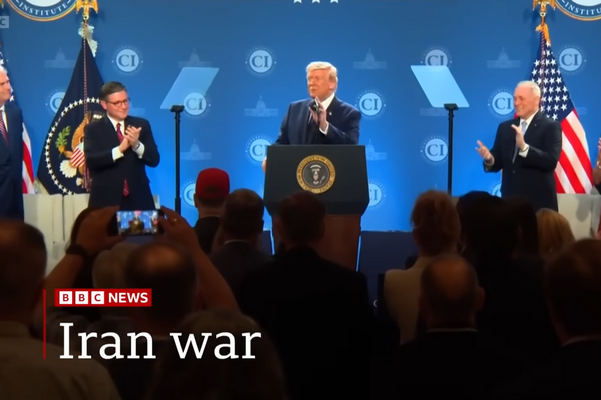
Trump says Iran war will be “over pretty quickly” as oil price hits 6 year high | BBC News
Trump Concedes Defeat In Iran War? Big Announcement As New Khamenei Rises Despite Israel-US Attacks
Be sure to ‘like’ us on Facebook












